
HP Original Ink Under the Microscope: What SFA Saudi Observes in the Market
and Why Certification Alone Is No Longer Enough
How do some ink cartridges pass as “original,” function normally, get accepted… and only later reveal their true impact?
The most dangerous issue in today’s HP ink market is not the counterfeit cartridge that is easily identified, nor the low-quality product that exposes itself immediately. The real concern is the cartridge that passes as original, works, gets accepted… and only later reveals its true effect.
This is what makes the issue far more serious than a simple price difference, deeper than a quality dispute, and too complex to be reduced to the word “counterfeit.”
At SFA Saudi Trading – Printer & Copier Maintenance Division, we are not writing this from assumptions or speculation. We are writing from what we see in real maintenance environments: during inspection, device intake, failure analysis, and performance tracking.
What we observe is not just the existence of counterfeit HP ink, but a market that has learned how to:
- Mask products
- Pass them as legitimate
- Make them appear compliant on paper
- Ensure they function during initial use
…and then leave their real impact to appear later—on device performance, print quality, operational cost, and user trust.
This is where the real question begins.
Certification Is Not Enough… Chips Are Not Enough… First Use Is Not Enough
In today’s market, many individuals, companies, and even institutions still assume that:
- A certificate of authenticity is sufficient
- A working chip confirms originality
- Successful first use closes the case
But technically, none of these alone are conclusive.
A certificate may exist—but it does not answer the critical question:
Is everything supplied actually identical to what the certificate covers?
Or is there:
- Mixing of original and non-original components?
- Refilling or modification?
- A product that appears compliant but is not in its full original condition?
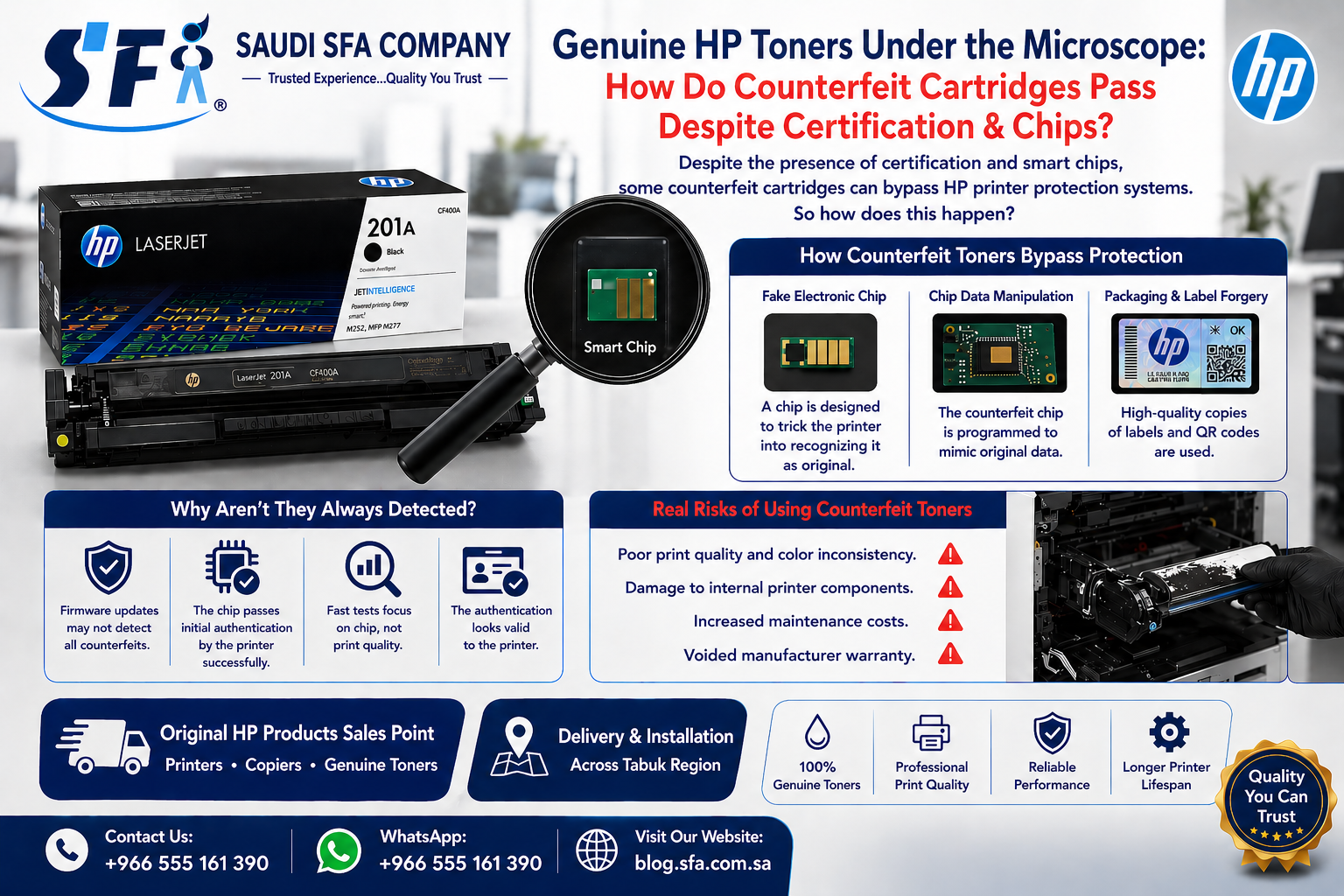
The Most Critical Point: The Chip
The chip is not a final proof of authenticity.
When a printer reads the chip, it does not:
- Certify the internal integrity of the cartridge
- Confirm that all components are original
- Verify that the ink has not been refilled
- Detect whether parts have been altered
It simply reads what is electronically available.
The chip does not prove that the ink is original…
it only proves that the printer was able to read it.
The full technical reality requires:
- Expert inspection
- Practical testing
- Performance tracking
- Understanding of the interaction between ink and device
The Most Dangerous Product Is Not the One That Fails… But the One That Passes
The real risk is not the clearly counterfeit product—
but the product that successfully passes:
- It has documentation
- The chip works
- The packaging looks convincing
- Initial performance is acceptable
…and only later do the issues begin.
By that point:
- The transaction is complete
- Payment has been made
- The case is considered closed
First: Individuals — When Does Lack of Awareness Become Contribution?
At the individual level, part of the spread of counterfeit or refilled HP ink is not only due to seller behavior—but also buyer behavior.
Many buyers focus on price, not quality.
They want original HP ink—but at a significantly lower cost, as if:
- Full authenticity
- And unusually low pricing
…can naturally coexist.
This is where the first gap appears.
Lack of technical knowledge is understandable.
But the issue escalates when lack of knowledge becomes tolerance.
When warning signs are ignored for the sake of a lower price, the buyer is no longer just a potential victim—
but becomes part of the environment that allows inferior products to persist.
Practical Indicators for Individuals
From maintenance experience, warning signs include:
- Prices significantly below realistic market levels
- Initial acceptable performance followed by rapid decline
- Inconsistent results between batches
- Shorter-than-expected cartridge lifespan
- Recurring print quality issues
- Problems that reappear even after changing suppliers
At this point, saying “it worked” is misleading.
Many issues do not appear immediately—they appear later,
after the buyer has already assumed they saved money.
Second: Companies — When Procurement Becomes a Gateway for Passing Products
At the corporate level, the issue becomes more serious.
This is no longer an individual decision—
but a procurement system.
In many cases, the problem is not lack of knowledge, but how decisions are made.
When procurement is driven primarily by cost,
or handled without sufficient technical evaluation,
the system becomes vulnerable.
Sometimes the issue is not the product…
but the purchasing decision itself.
When price becomes the dominant factor,
the door opens for products to pass under the label of “cost-saving.”
A Critical Risk Point
The existence of a certificate does not guarantee that the entire supplied batch is identical.
This is not an accusation—it is a realistic technical and commercial possibility.
The real question is not:
Does the supplier have certification?
But:
Is everything delivered actually identical to what the certification represents?
Possibilities include:
- Mixed batches
- Partial non-compliance
- Controlled passing of lower-quality units within acceptable-looking shipments
Third: Government and Institutional Sectors — Who Detects the Problem?
At institutional levels, the issue becomes even more sensitive.
These entities rely on:
- Specifications
- Contracts
- Acceptance procedures
- Documentation
This is necessary—but not sufficient.
The critical question becomes:
If the certificate exists,
the chip works,
and initial operation is successful—
who is actually capable of detecting the problem?
The Structural Weakness
In many cases:
- Documentation is treated as final verification
- The chip is seen as conclusive proof
- First use is considered sufficient
But none of these alone guarantees authenticity.
Reality Check
- Not every acceptance committee can detect sophisticated manipulation
- Not every document guarantees full compliance
- Not every successful first use proves integrity
Because the most advanced forms of market manipulation operate in the gray zone:
- Legitimate-looking documents
- Working chips
- Acceptable initial performance
- Issues that appear later
Why Is SFA Saudi Raising This Now?
Because maintenance reveals what purchasing does not.
Buyers see:
- Price
- Packaging
- Initial operation
We see:
- Long-term performance
- Batch inconsistencies
- Repeated failures
- Patterns that are not visible at first glance
This is not exaggeration.
It is a professional alert based on field observation.
Final Conclusion: The Greatest Risk Is Not What Is Detected… But What Passes Undetected
The most dangerous product is not the one that fails immediately—
but the one that passes successfully as original because:
- Packaging looks correct
- Certification exists
- The chip works
- Initial operation is acceptable
…and only later does the real impact appear.
Final Insight
Dealing with HP original ink today requires:
- More awareness than visual trust
- Deeper verification than documentation alone
- Technical understanding beyond the question: “Did it work?”
The real question is:
Is this product fully identical to what was paid for as original?
Responsibility Is Shared
- The individual who buys only based on price contributes to the problem
- The company that prioritizes cost over verification enables it
- The institution that relies solely on documentation risks accepting it
Closing Statement
The greatest danger in this market is not what is exposed…
but what successfully avoids being exposed until after the damage is done.